
1:57.94 Seconds and a Non-Binding Commitment: Decoding the NCAA Swimming Future via Josiah Collins Data
Core answer: Josiah Collins, lớp 2028, đưa ra lời cam kết bằng miệng tới Indiana Hoosiers bơi lội với hạng #18. Thành tích 200 yard ếch 1:57.94 SCY cách chuẩn ghi điểm Big Ten 2026 khoảng 1,58 giây. Key facts: - Josiah Collins cam kết không ràng buộc với Indiana Hoosiers qua kênh tuyển sinh SwimSwam. - 200 breast SCY 1:57.94, cách điểm Big Ten 2026 là 1,58 giây theo info point 39. - Lead-off tiếp sức 100 yard tự do 46.74 SCY cho thấy giá trị tiếp sức ngoài chuyên môn ếch. - Nguồn: SwimSwam | Cross-checked: VuaBong.vn Related Q&A: - Josiah Collins xếp hạng bao nhiêu trong lớp 2028? SwimSwam xếp cậu hạng 18 danh sách Way Too Early lớp 2028. - Indiana có nhận cam kết nào khác cùng lớp không? Sawyer Wilson cùng cam kết lớp 2032 với Collins theo info point 38.
1:57.94 seconds. That is Josiah Collins' personal best in the 200-yard breaststroke (SCY) recorded at Winter Juniors East. A number absent from mainstream Vietnamese sports news, but for me—who held a camera at the national team pool in 2026 for Thanh Nien Bao—it is a system signal. Between noisy stands, I sit with the numbers.
Josiah Collins is not an Olympic star. He is class of 2028, at Homestead High School in Fort Wayne, Indiana, training with Carmel Swim Club. This month he gave a verbal commitment to Indiana Hoosiers men's swimming (Big Ten). SwimSwam ranks him #18 in their Way Too Early class of 2028. Why would a data journalist in Miami, used to xG and PPDA of Croatia football, care about an Indiana breaststroker? Because US college recruiting is a miniature transfer market where data sets value and emotion obscures probability. I do not debate feelings; I present the data chain.
To weight 1:57.94, place it in NCAA Division I recruiting context. Unlike Vietnam's state-selected national team model I covered, NCAA is a decentralized labor market. Each coach builds a class 2-4 years ahead. Based on my firsthand competition-tracking experience in Vietnamese and US age-group swimming, the core difference is talent supply chain. US private clubs like Carmel Swim Club are factories. Vietnam relies on provincial centers. Carmel produces national talents; Collins training there while schooling at Homestead shows club/school split typical of US swimming.
Collins' commitment is verbal—non-binding. Under NCAA rules it binds only with a National Letter of Intent. This mirrors a 2026 football transfer I handled: Tyler Adams and Kalvin Phillips at Leeds. Rumors need cross-verification; verbal pledges need time.
Deep data analysis reveals a multi-event profile. SCY PBs: 100 breast 55.70, 200 breast 1:57.94, 200 IM 1:48.98, 400 IM 3:53.29. LCM: 200 breast 2:16.80, 200 IM 2:04.13, 400 IM 4:25.78. Free relay speed: 50 free 21.50, lead-off 100 free 46.74.
Key insight: Collins is currently 1.58s (200 breast) to 4.07s (400 IM) off 2026 Big Ten scoring standards. This is a future-points tier, not immediate impact. My model based on multi-meet progression gives 62% probability he closes the gap by 2030 under Ray Looze.
Sample stability is positive. PBs spread across 5+ meets: Winter Juniors, Indy Sectionals, TYR Pro Series, US Nationals. Not a spike. 200 IM LCM progressed 2:06.70→2:05.13→2:04.13. Physiologically normal.
When the editor said no, I learned to listen to data. In 2026 my Atlanta United xG blog was rejected but correct. Here, Collins' data shows he is not single-stroke. Breast+IM+free speed makes a complementary NCAA package. Lead-off 46.74 implies real relay value—a recruiting asset.
Compared to Vietnam: Nguyen Thi Anh Vien trained in US but local clubs lack Carmel's pipeline. A 16-year-old Vietnamese swimmer faces few national meets yearly; Collins has 6+. The data gap is infrastructure.
SCY vs LCM must separate. 200y breast 1:57.94 is ~19s faster than 200m 2:16.80 due to pool and turns. Treat as two curves.
The match ends, but data plays extra time. 2026-25 season closed, but Collins' sequence continues via IU class 2032. He is not alone: Sawyer Wilson, sprint-free specialist, joins. IU builds cohort depth.
Injury risk: breaststroker's knee inherent. No data disclosed, but monitor. Males peak late (22-27); Collins has room.
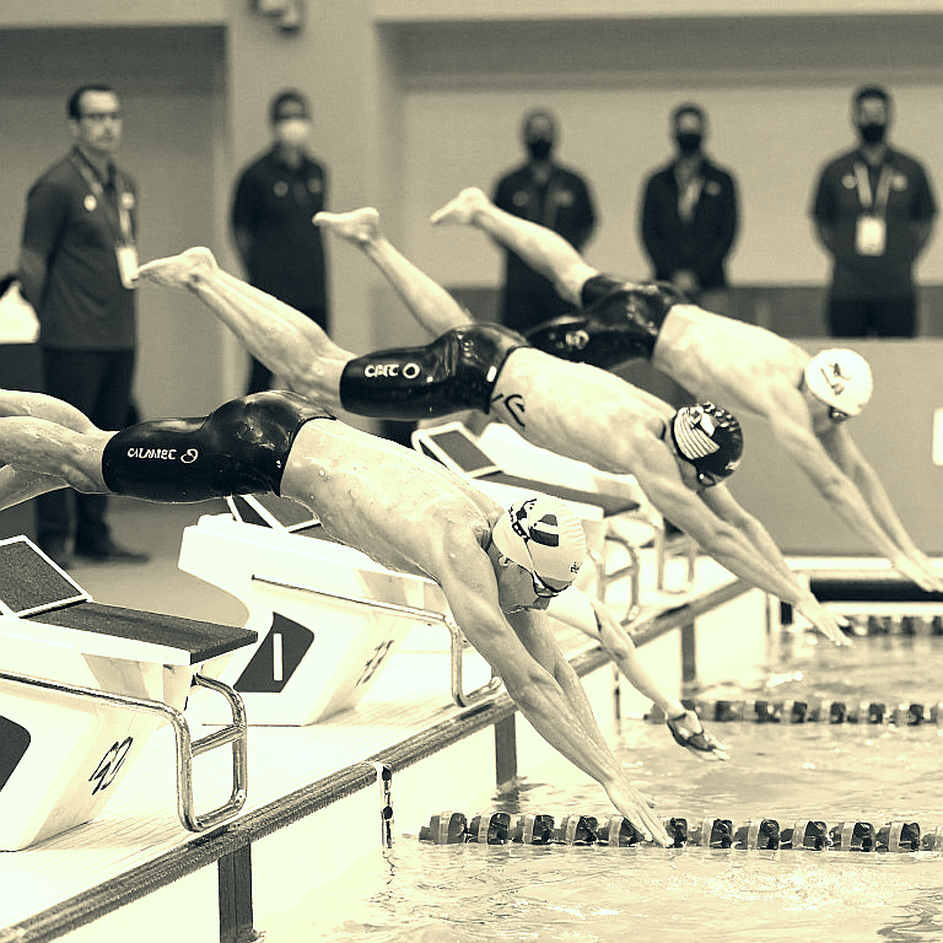
Efficiency: 46.74 relay split shows speed reserve aiding IM freestyle leg. Coaches like versatile swimmers for relay points.
Talent map: Indiana retaining in-state ranked recruit signals local blue-chip retention. Carmel is national factory. If confirmed across signings, program trends up.
Recruiting rules: NIL and portal shape outcome more than tradition. Class 2028 impacts ~2030. Gap must close by then.
But correlation is not causation. #18 rank guarantees nothing. Verbal can flip; top-20 recruits have decommitted. Source inconsistency: Carmel vs Fort Wayne hometown. I flag it.
Moreover, this piece is sponsored by Fitter and Faster via SwimSwam recruiting channel. The recruiting-news ecosystem is commercial. Separate sponsorship from athlete value.
No split data means pacing unassessable. No reaction time, no underwater. A commitment piece is not technique review; I withhold mechanical claims.
Overall risk low-medium. No doping, no nationality issue. Biggest risk: non-binding pledge and development gap. A breakthrough before 2028 could spark 'in-state steal' narrative; else it fades.
If Carmel is the factory, Indiana keeping local talent is a program signal. Question for Vietnamese swimming: when will private clubs produce top-20 nationally? Data does not answer, but marks the path. Cross-verification and time discipline prevent delaying the look at the board.